Farmers’ Markets: Past, Present, Future Part II – From Farm to Table

Happy National Farmers’ Market Week! In honor of the week, here’s my second post from the series, “Farmer Markets: Past, Present, Future“.

Back in July, news editor Gwen Guerke shared my Facebook post in the Milford Chronicle, in which I thanked our Riverwalk Farmer’s Market customers for supporting LWP in the 100 degree heat on July 7. I also shared that we sold out of 2500 ears of corn by 11:30 am. Since then, many customers have commented to me, “Did you really sell 2500 ears?” Yes, we did. But this is normal. We always pick approximately 60 baskets (42 ears each=2520 total ears) for the market each Saturday. It usually lasts until noon time, sometimes 12:30. What was abnormal was the fact that we sold all 60 baskets by 11 am that day, which was most likely because of the heat. Many of our customers choose to beat the heat by coming early, as we open around 9 am. The past couple Saturdays have been this way, as the heat and humidity in DE has not let up. I usually have time to clean up, consolidate baskets, and talk to customers but not when everyone comes out at once!

You may think, “What’s the problem? Isn’t selling out the goal?” It is and I’m not complaining. But Gwen hit the nail on the head with her next statement in the column. She wrote, “Think about this though: before the market opens at 9am Saturday, someone had to go out in the fields and harvest each and every ear. A lot of time and effort goes into the “Farm to Table” concept, so when you’re buying fresh and local fruits and vegetables take the time to thank the people who put in the work to make it happen.”  She’s right. More recently, many customers have been asking me if we picked the corn that morning. I tell them the truth, which is we usually have to pick some the night before and the rest in the morning. Why? Because even though we start picking corn at 5:30 am on Saturday mornings, we can’t get it all picked and packed by 8am, which is when we have to leave to get to Milford. Who’s the we? It’s usually Farmer Dan (my Dad), Breck (my brother), Uncle Doug, and Melissa Baker (a long-time, dedicated employee) and myself. We typically can pick one full basket every 10 minutes, which is about 6 baskets an hour. Therefore, 5 people picking corn can accomplish approximately 60 baskets in 2 hours but keep in mind we have to pick enough to keep our home retail stand going, too, as well the Western Sussex (Seaford) market and other wholesale orders. Additionally, it’s wet, so we wear rain suits to stay dry. There is usually minimal air movement as well, although it’s very peaceful. Here’s a You Tube video to give you an idea of what it’s like in the corn field: http://youtu.be/JknGLcKtGZU. At the beginning, you’ll see Dad actually husk an ear and taste it. He loves to do this and it’s his way of ensuring the planting is good. And here are some pics to share from the corn field:
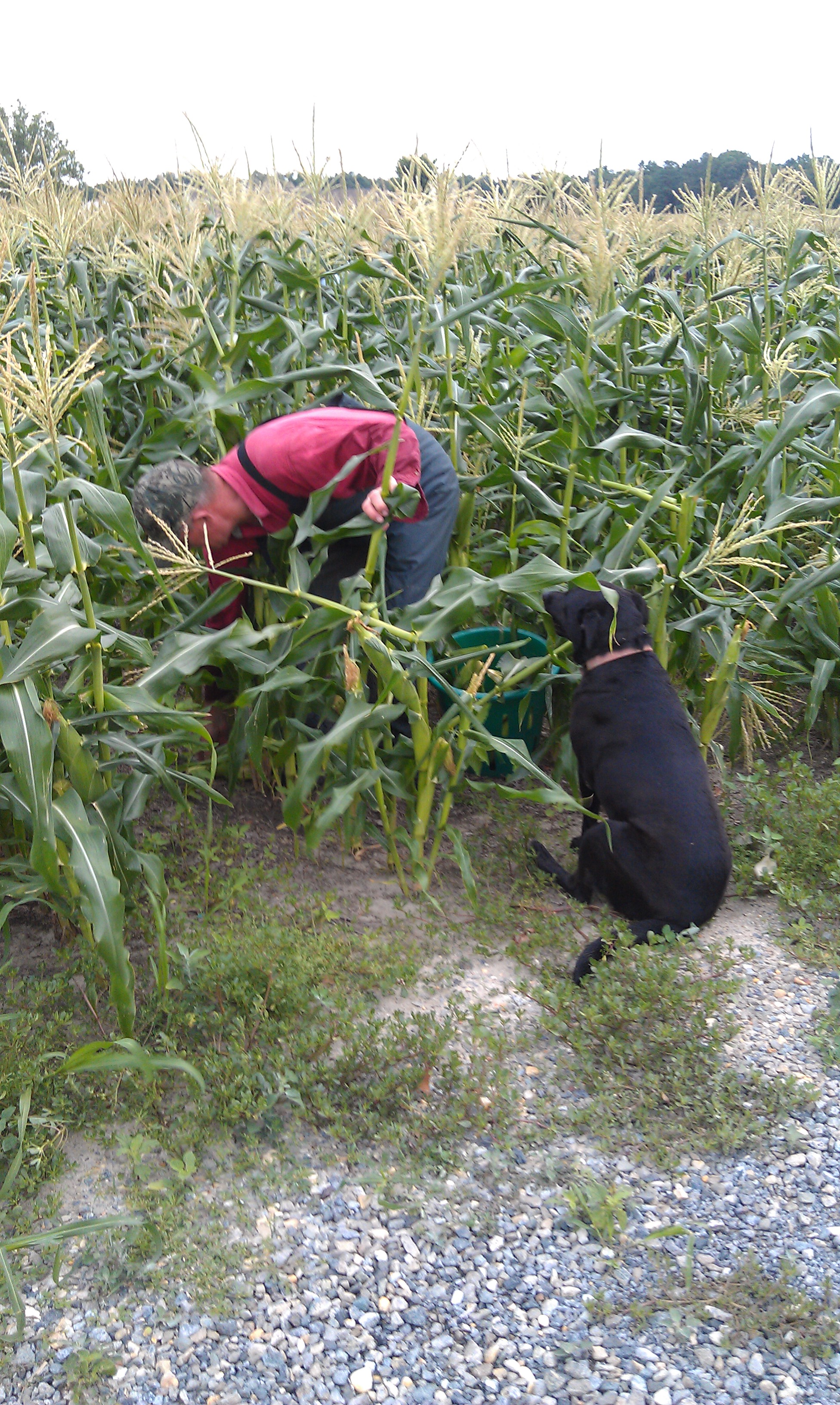
Love this picture because it shows how much Uncle Doug has to bend over to pick sweet corn. But it also shows how much animals love him. Here Pansy is waiting for him to feed her an ear of corn, too.  🙂
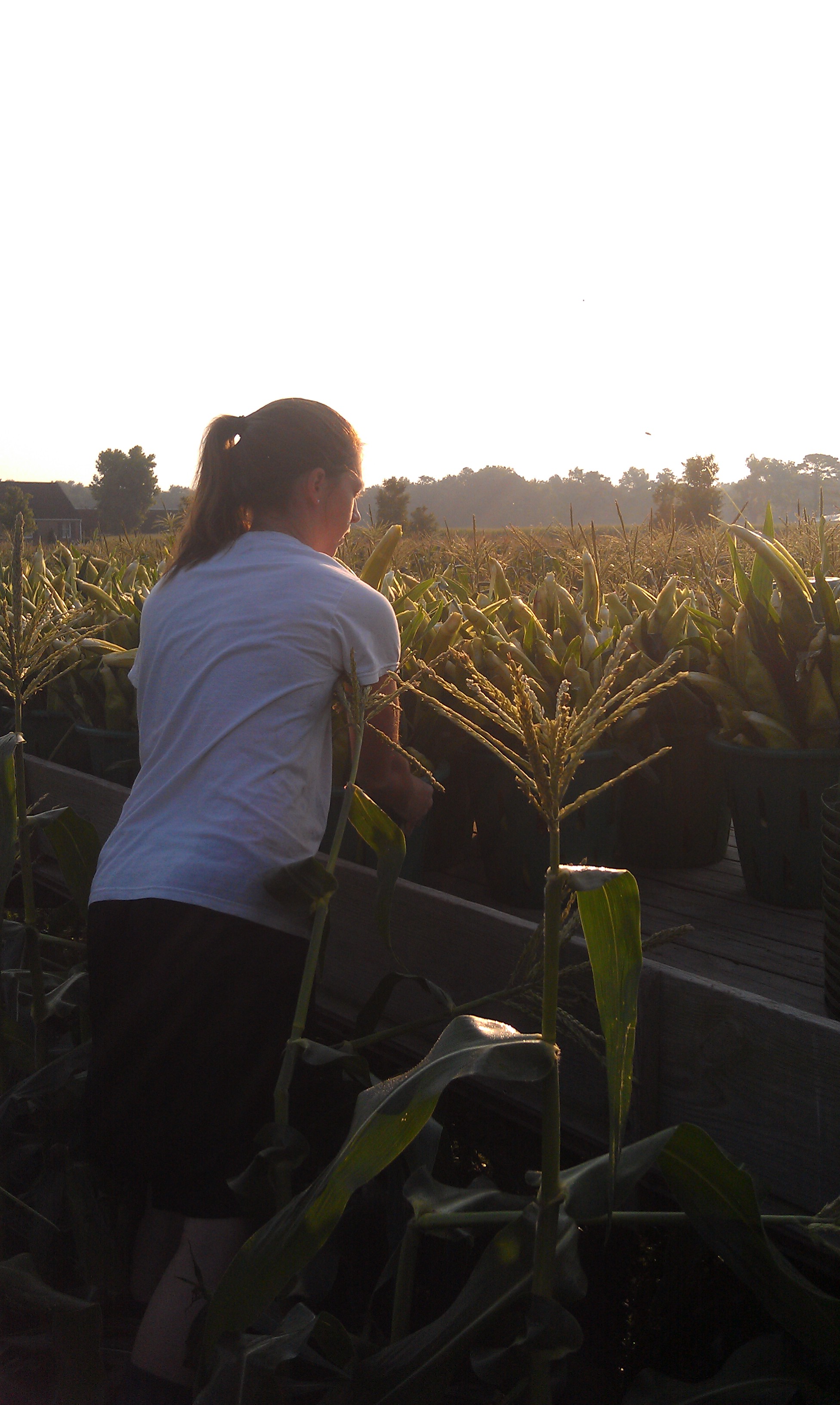
Here Melissa is throwing a full basket on the corn wagon. It helps that she’s a lot taller than the wagon (unlike me!). 🙂

Any volunteers to help us pick this Saturday? If so, see you at LWP around 5:30 am. Otherwise, we’ll just see you at 9 am, with 60 baskets already grown, picked, packed, and delivered straight to you, the consumer, at the Riverwalk Farmers Market! Oh yea–and thanks to Gwen, for understanding and shining light on exactly what is “Farm to Table”!

Farmers’ Markets: Past, Present, Future Part I – Getting Started

Did you know there are 27 farmers’ markets in the First State? Many are opening this weekend, including the Western Sussex Farmer’s Market in Seaford. They’re popping up everywhere! So, have you visited one yet? If not, you might be missing out on what has become the nucleus of most downtown’s thriving economies. Last year, with only 16 markets, sales totaled $1.8 million. It’s like having your good old corner store, with a produce section, in walking distance of your favorite coffee shop, restaurant, bank, and bakery shops. I bet there’s one near you, with 12 new locations opening this summer. Check out the Department of Agriculture’s directory for locations and times.

But believe it or not, the idea is not new. Many markets such as Lewes and Milford began over ten years ago. I’ve had the pleasure to participate in several through my work with my parent’s business, Little Wagon Produce. I got the call to help my Mom in downtown Milford five years ago, as she could no longer handle the volume by herself. In 2001, she began to transport fresh produce to Milford every Saturday morning. It took years for her to establish the LWP  name in Milford and I’m proud to witness and learn from it.  The work  and time required has not been easy. In order to build this market over a decade, Mom had to be:

  1. dependable– this means you have to show up every week of the market. It allows customer’s to rely on you and what you offer. This is hard for small farmers who do not grow large volumes.
  2. communicative– you have to take the time to talk and listen to the customers to find out what they like, need, and want! Then you have to follow thru and either provide it or help them find it!
  3. educative– you have to take the time to help customers understand what you grow and what you do to get it to the market every week (planting, picking, packing, refrigerating, loading, fuel for transporting, labor, etc).
  4. collaborative– you have to support the market by working together with fellow vendors. Each week Mom makes a round to buy from other vendors and we love to send customers to other vendors. For example, we send customers to co-vendor Tracy Riley of Houston Country Gardens when they ask for perennial flowers, since we only grow annuals, and she does the same for us.
  5. and embedded in the community– it helps to know customers by name, where they work, and what happened last week in the news. We do not live in Milford, but we make it a priority to frequent its businesses and events often.

The best part about farmers’ markets is getting to know our customers. He or she could be the town mayor, a local school teacher, or a retired grandparent. They then go out into the community and tell everyone to go downtown for the “awesome sweet corn” from Little Wagon. Word of mouth truly is a small business’s best advertisement.

Personally, the market has afforded me many opportunities. I feel embedded in the Milford community myself. I have met several people I now consider friends, such as the local postmaster (he likes to hug me), a local news reporter (she likes to talk about running), and a fellow co-worker’s dad (he likes to pick on me and calls me “corn-girl”).  I love to be outside and I admit, its great exercise, too. Do you know how hard it is to pack and unpack two box trucks?!! It’s also my way of staying involved in the family farming business. I love to help customers understand the seasonality of produce and how to pick it. It’s great to be able to spend time with my family. Not only do I get to learn from Mom but I also get to see my grandfather, Pop-Pop Bob. He doesn’t like to miss a Saturday and gets several hugs and kisses from customers. I also have a good friend, Wendy, that shares my love for the market and comes every week to help us.  My younger sister, Amber, has recently joined in on the weekly ritual as well.

I plan to continue writing about farmer’s market activity throughout the summer. But I can’t end this post without saying thank you to all of our farmer markets’ customers. We appreciate your time and business and I hope my family can continue to serve local communities with fresh, local food for a reasonable price. In today’s world, I truly believe we take our easy access to food for granted.

Becky Vanderwende (Mom) at the 2005 Strawberry Festival explaining to the customer how to best care for the flowers she’s about to purchase.

Seaford Farmers Market

Mom and Dad always said to not be afraid to show customers our produce. We understand that people want to see that the product is good. I love showing them how full our ears are and how good it looks!