DE House Agriculture Committee Update

As a quick follow-up to my previous blog, “Proposed Changes to DE Nutrient Management Commission”, House Bill 282 was released from the House Agriculture Committee meeting last Wednesday, April 25. In order to be released, it required a majority vote from the House Agriculture Committee members. Rep. John Atkins called the meeting to order. Rep. Dave Wilson, sponsor of the bill, quickly introduced the bill. Rep. Bill Carson made the motion to release this bill from committee. Rep. Quinn Johnson seconded. There was no discussion and no opposition. Other elected officials present were Rep. Bobby Outten, Rep. Harvey Kenton, and Rep. Jack Peterman. Secretary Ed Kee was in attendance as well as the Staff Administrator of the DE Farm Bureau, Ms. Pam Thornburg-Bakerian.  The bill will now be placed on the ready list or on the agenda, to be worked on the House floor. The meeting was adjourned.

Hopefully this won’t hurt poultry representatives in the long run when an important decision is made. However, I should share an article I read in the News Journal this week titled, “High prices, slow sales ground Delmarva poultry”…..

Check back for an update on DE Joint Agricultural Committee minutes soon.

Proposed Changes to DE Nutrient Management Commission

It’s hard to find a poultry farmer in New Castle County, which makes it hard to fill the Nutrient Management Commission. And so became House Bill (HB) 282, which changes the composition of the Commission.

As with many state boards and commissions, the Delaware Code relating to this Commission is very specific and can be very confusing. Bear with me! Currently, there are 15 total voting members on the Commission. One is the Director of the Division of Watershed Stewardship for DNREC. The 14 others are appointed by various elected officials. Of the 14 appointed, 7 must be full-time farmers. The 7 full-time farmers must be divided by county. For example, 2 must be full-time farmers from New Castle County, 2 from Kent County, and 3 from Sussex County.  Even more specifically, the 7 full-time farmers must consist of:

  • 1 dairy farmer
  • 1 swine producer
  • 3 poultry farmers
  • 2 row-crop farmers (1 grain and 1 vegetable)

If enacted, HB 282 would remove 1 poultry farmer from the Commission while adding 1 equine operation owner.  Currently, Delaware’s equine industry has no representation on the Commission. I’m assuming this change will cater to New Castle County because of a lack of poultry, swine and row-crop farming. In other words, representation for this county would have to come from the dairy and equine industries. While I understand the desire for representation of the equine industry and every county, I have concern for the representation of less poultry farmers. The fact is clear: poultry is Delaware’s #1 agricultural commodity. Of Delaware’s cash farm income, 73% was from broilers in 2009. We are 8th in the nation in the value of broiler production. As a matter of fact, broiler production began in Delaware. Need I say more?

Yet, this industry (and all of agriculture) is under pressure from federal regulation and environmental activists who say we need more rules for animal waste (i.e. nutrient management). Take yesterday’s DE State News, for example, which featured a guest commentary from a Washington DC environmental guru who blames agriculture as the top single contributor of nutrient pollution to the Chesapeake Bay. She cites poultry farmers specifically, claiming they grow too many birds and produce too much waste without controls on waste disposal. This is exactly the duty of the DE Nutrient Management Commission: to regulate activities involving the generation and application of nutrients in order to help improve and maintain the quality of Delaware’s ground and surface waters and to meet or exceed federally mandated water quality standards, in the interest of the overall public welfare. Therefore, I would advocate for more poultry farmers on this Commission; not less.

Have all other options been properly considered? Could the county representation requirement be changed? In other words, maybe there should only 1 full-time farmer from New Castle County represented? Perhaps the swine producer should be removed? I could be wrong, but I haven’t seen a large-scale pig farm in Delaware in a very long time (1980’s?).

DISCLAIMER: I guess I should go straight to the source. My grandfather co-chairs the Commission. I also have 3 family members who are poultry growers. I’ll do my homework. Until then, here’s a link to a list of members from the DE Dept of Ag website but it’s not current. This also made me wonder: Does the poultry industry have a registered lobbyist in Delaware to advocate for poultry growers in our state?  I looked it up under the Public Integrity Commission website. The answer is yes. It’s Bill Satterfield from the Delmarva Poultry Industry. I read their March 2012 newsletter, which explained that all current legislative efforts are focused in Maryland because of the dozens of bills that could affect the MD poultry industry. Too close for comfort, if you ask me……

“Smart Growth” in Delaware

It was so refreshing to attend the 4th annual DE HEAL summit today in Dover. HEAL stands for Healthy Eating & Active Living and is a coalition of 200 individuals who want to improve the health of Delaware. The theme of today’s summit was “Impacting Obesity through Environmental & Policy Changes”. Words I heard throughout the day were: land use planning, complete communities, walkable, bikeable, smart growth, open space, built environment, healthy living and more.

How does this topic relate to agriculture? Obviously, farmers are the key to providing the fresh food necessary to decrease obesity rates. But also because the idea of farmland preservation fits in perfectly with the idea of “smart growth“. There are individuals  and groups who are currently advocating to make communities more livable, INSTEAD of creating more developments on more land (also known as sprawl); leaving more space open and family farms intact. One such group is DE Greenways.  I sat in on their breakout session today and learned more about the work they’re doing in the Rehoboth Beach area. They are essentially helping to “retrofit” the land already developed at the beach to make the area more livable. How? By connecting existing roads and trails, creating bike and pedestrian friendly areas, and communicating these areas to the public. Ever heard of the Breakwater Junction Trail? DE Greenways advocated for this 6 mile trail, which connects Rehoboth and Lewes.

There is definitely a cost savings associated with improving current infrastructures. The further we sprawl, the further we must provide transportation, emergency, and medical services to residents. Along the same line of thinking, to ensure the future of Delaware agriculture, the preservation of farm land is essential. We are lucky to have a state preservation program, which was initiated in 1991. Twenty years later, Delaware has preserved almost 130,000 acres.  Smart growth ideals and farmland preservation principles go hand in hand.  We should advocate together!!!

All Good Things Must Come to an End

All within one event, several chapters came to an end this past Friday, March 16th:

  • A breakfast series, called “Friends of Agriculture”, sponsored by the University of DE Cooperative Extension. For several years, anyone from the community could come “listen and learn” to ag oriented speakers at early morning breakfast meetings. Previous speakers have been Governor Jack Markell, Senator Tom Carper, and the most recent presenter: DE Secretary of Agriculture, Mr. Ed Kee. The title of the presentation was, “Brazil’s Ag-to the Horizon”. The Secretary toured the country with 18 Delaware farmers to experience Brazilian agriculture first hand. The take-away? Brazilian farmers are good at what they do; ranking 5th in the world in grain production. However, they are grappling with transportation, preservation, and regulatory pressures. Much more so than American farmers. The Secretary concluded with this statement: “The Delaware and American Family Farm System is the world’s best ag system and we will continue to compete and thrive!”
  • The moderator for the series: Dr. Jan Seitz. She is the Director of Cooperative Extension and is retiring as of next month. She promises to remain a Delawarean in retirement and from what I understand, she has initiated a scholarship fund with the DE Community Foundation for in state students. She’s a strong advocate for Delaware agriculture, extension, and 4-Her’s!
  • The main supporter of the series: Dean Robin Morgan. She is the current head of the University of Delaware College of Agriculture & Natural Resources but also is retiring at the end of this academic year (May or June?). Her replacement has not been selected or announced as of yet but I’m guessing the announcement will come soon.

All of these good things are coming to an end. The continuation of the breakfast series will be up to the new Dean but perhaps it is time to revamp the series? I hope to broach the topic with some of the boards I serve on. Youth involvement or some sponsorships could make it happen.  Let me know if you have any ideas: cvanderwende@hotmail.com.

Where Did Winter Go?

I was supposed to rest this winter. So much for that. I’ve been going non-stop in my spare time and much has been for ag related purposes. So much, in fact, that I didn’t blog the entire month of February. Right after the annual DE Ag Industry dinner, I began an 8 week class called Annie’s Project, on Wednesday nights. The first weekend of February I attended my 2nd conference for Common Ground in Charleston, South Carolina…and here it is March already and my family is back in the greenhouse.

To catch up for lost time, here’s a recap of national and state ag related news or events I’ve been following this winter:

  • First woman elected Chair of the United Soybean Board:Meet Vanessa Kummer
  • DE Public Archives released an Agriculture Photo Collection from Delaware in the 1920’s and 1930’s (I loved seeing many of the old farm practices captured in these pictures as well as some 4-H events!)
  • UD names new head of Cooperative Extension: Meet Ms. Michelle Rodgers (her start date is April 2nd!)
  • USDA closes 259 offices, including consolidation of 131 FSA offices (this link is the latest article from March 3)
  • Bill Gates Endorses Ag Research  (or watch  this Bill Gates video, supporting genetically modified food research) Our industry could use his voice more! I’m so glad he spoke up!
  • Annie’s Project Convenes (more to come on this 8 week agribusiness course for women) I graduate tomorrow night!
  • Common Ground launches new website: www.findourcommonground.com (more to come on this, too, but this website is an awesome resource to answer popular consumer questions) Take a few minutes to check it out!
  • Regional Women in Ag Conference was February 9-10, 2012 (I couldn’t find any media on this and I didn’t make it this year because of my full-time work but heard it went well!)
  • DE Farm Service Agency (FSA) Director named: Meet Mr. Bob Walls
  • National Ag Week & Agricultural Safety Awareness Week was March 4-10, 2012 (sponsored by the National Education Center for Agricultural Safety because it is one of the most hazardous industries)
  • National Ag Day was March 8, 2012 (sponsored by the Agriculture Council of America)

This is a quick list, but as you can see, there’s been no shortage of agriculture news and events this winter. With the early arrival of mild weather, it looks like there will be no rest for the weary in between seasons.  By the way, the first day of spring is next Tuesday, March 20. Just where did winter go?

2012 DE Ag Industry Dinner: “Spreading the Gospel of Agriculture”

It was a nice night. The Dover Downs venue makes this annual occasion very formal. And thanks to the impending election year, it was well attended (or crowded, however you want to look at it). There  were politicians everywhere, both state officials and our 3 U.S. Congressmen. The food was good and yes, of course, Delmarva chicken was on the menu! It was a very late night since every Congressman gave welcoming comments and the featured guest, U.S. Secretary of Agriculture-Tom Vilsack, was last to give the key-note address. His speech gave indebtedness to farmers; thanking them for their efficiency (production crops) and innovation (biofuel) and most of all, for providing Americans food security.

This year the Secretary’s Award for Distinguished Service to Agriculture went to two prominent names in the Delaware agriculture community: Bruce Hotchkiss and Michael Scuse. The latter is a former DE Secretary of Agriculture and currently an Under Secretary for the USDA. But most importantly, he is a farmer from Smyrna, DE. The first is the founder of the widespread Delmarva Farmer; a voice for farmers across the Mid-Atlantic. He is from a NJ dairy farm but spent 57 years as a reporter. Of the entire night, I enjoyed Mr. Hotchkiss’s words the most. He broadcasted the fact that agriculture across the country is under assault from organization’s such as the Water Keeper’s Alliance and the EPA.  But he also publicized that organizations are blossoming up everywhere, to reeducate the public on the gospel of agriculture. He encouraged the crowd with two very small words: JOIN THEM!

This week I travel to my second CommonGround Conference. I hope to learn more media training so I can effectively advocate for farmers. I joined CommonGroundto spread the gospel of agriculture.

L to R: Mr. Bruce Hotchkiss and Mr. Michael Scuse- Both 2012 Distinguished Service to Agriculture Awardees

How Will We Feed & Fuel Ourselves?

The brisk temperature didn’t keep many away as friends of Delaware Agriculture trickled into Harrington Fire Hall last Friday morning for an early morning breakfast. It was nice to see so many youthful faces present from 4-H State Teen Council representatives, and DE FFA State Officers, to Del-Tech FFA members.

Jan Seitz, Director of Extension, jumped right into the program by introducing the 2012 George M. Worrilow Award winner, Dr. Jack Gelb. Known for his poultry research and publications, he is the Department Chair and a Professor for Avian Virology at UD. Seeming very humble, Dr. Gelb spoke about his interest in agriculture without coming from ag roots. Noting a strong interest in science, he rode the “1st green wave” of ecology and attracted to ag because of the inspiring people in faculty and extension areas. He also felt he could make a difference in ag. His comments really resonated with me, especially after the recent Yahoo article which cited agriculture as the number one most useless degree. The author obviously never met Dr. Jack Gelb and most likely has never bit into a juicy tender chicken breast grown on the Delmarva Peninsula.

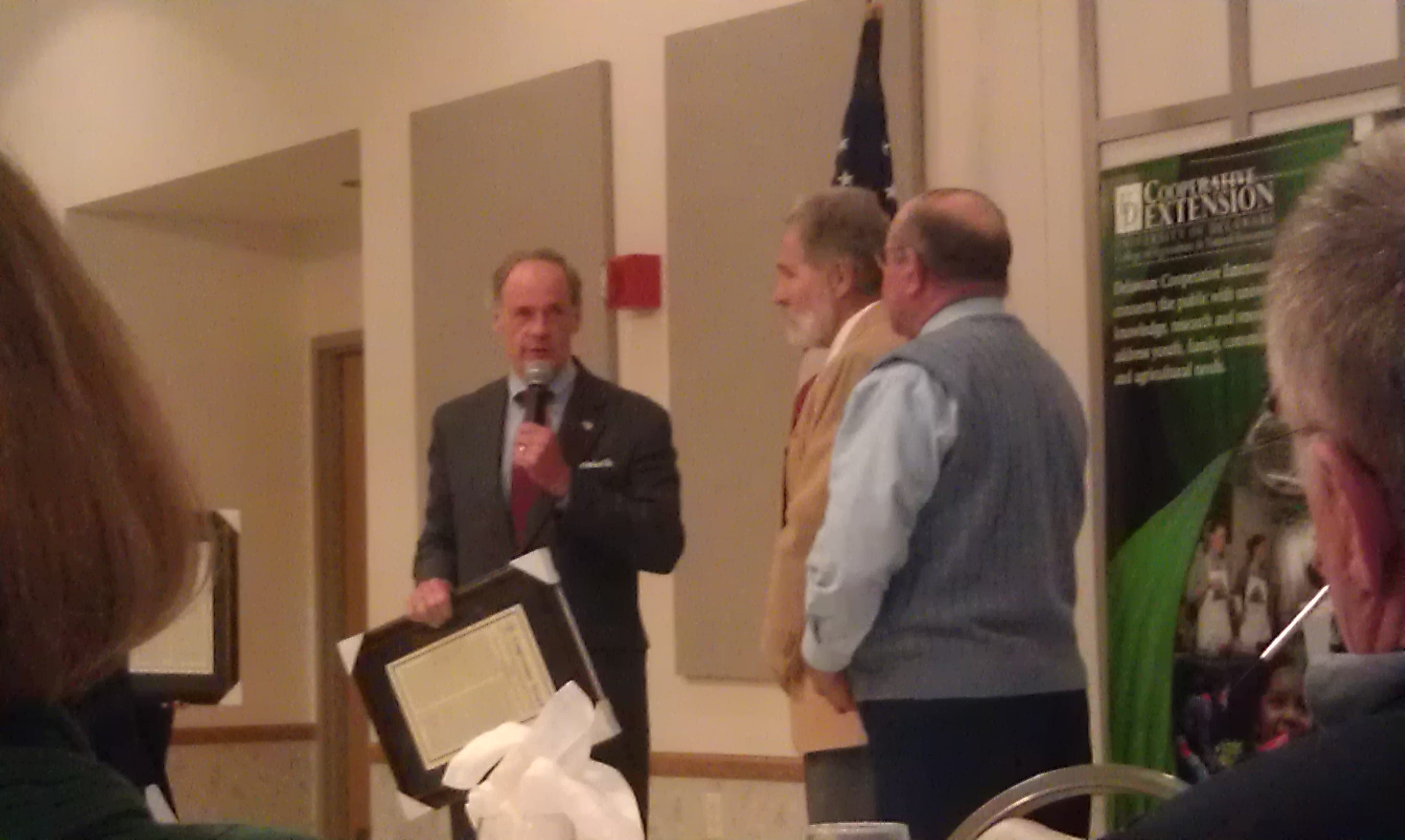
Scheduled to headline the program was the Governor, Jack Markell and our senior U.S. Senator, Tom Carper. The Governor was a no-show and the Senator was late but the show went on. Replacing the Governor, DE Secretary of Agriculture-Ed Kee, spoke on the new programs recently initiated for DE farmers such as DRIP and the Young Farmer Program. He also announced that the recent CAFO (Confined Animal Feeding Operations) regulations DE proposed were officially approved. Senator Carper finally arrived and reminisced on the environmental woes of the Inland Bays, which occurred during the Castle administration and derived the need for a Nutrient Management Commission. The members of this commission were to represent various sectors of all involved in nutrient management processes; requiring all to have a seat at the table and collaborate on a state plan. With the recent CAFO proposal being approved, Carper called this a huge accomplishment and wanted to honor the chairmen of the board, who have served since its inception. He presented a “Congressional Record” to Dave Baker, Vice-Chair and Bill Vanderwende, Chair (and my grandfather).

From Left: Sen. Tom Carper, Dave Baker-New Castle County Farmer, Bill Vanderwende-Sussex County Farmer

He ended by mentioning economic prosperity and that our economy is rebounding; not due to the usual consumer buying and housing industries but instead due to manufacturing and agriculture industries. He said he is hopeful about our future and we should only be concerned with 2 questions going forward: How will we feed ourselves and fuel ourselves? He stated agriculture has the answer in biofuel and efficiency. Isn’t it a shame the Yahoo author wasn’t sitting in the audience….?

New UD Cooperative Extension Director Named

Michigan State’s Michelle Rodgers to lead UD Cooperative Extension:

http://www.udel.edu/udaily/2012/jan/rodgers-extension-011712.html

Are there Food Deserts in Delaware?

The answer is yes.  Delaware has fifteen to be exact. So what is a food desert? Simply put, it’s a geographic area in the U.S., particularly lower-income communities, where access to affordable, quality, and nutritious food is limited.  The term originated in Britain, but it became a “buzz word” after being referenced in the 2008 Farm Bill, as a focus of the popular “Let’s Move Campaign”, championed by First Lady Michelle Obama. In 2011, the USDA introduced a new online tool, the Food Desert Locator, to map food deserts across the country.

Where are the deserts in Delaware? I used the online tool to find out.

–        11 are in New Castle County (scattered across the county and in the city of Wilmington)

–        3 are in Kent County (all located near Rt. 13 corridor in Smyrna, Dover and Harrington)

–        1 is in Sussex County (located east of Millsboro)

I suppose I understand the large number in northern part of our state but I don’t understand the reason for large pockets down state, where agriculture is still prominent.  Kent and Sussex Counties boasts the highest number of farms and crop land; vegetable and fruit production are abundant.

How does this affect Delaware agriculture? Farmers near these limited access geographic areas could fill the void by providing fresh, local food to outlets such as schools, corner stores and even grocery stores. The establishment of farmer’s markets in these areas could also increase access while providing farmers with an additional nearby outlet for yields.  However, the challenge is communication and planning; coordinated efforts must inform farmers prior to the growing season so they can order seed, plant adequate quantities, find labor for harvest, set pricing and account for transportation to new outlets.

So what does this mean for Delaware? Research suggests that residents who have better access to food retailers tend to have healthier diets and lower levels of obesity. The presence of these deserts in our state poses a threat to our entire population health, including children and elderly populations. Our state will have to figure out how access can be improved, which is no easy task since these deserts can be linked to income, race, and mobility.

Combined, I believe the conception and visibility of food deserts allows our state and Delaware agriculture the opportunity to assemble a “built environment”; meaning one sector cannot fill the void of access in a given location on their own. It will take many entities of Delaware farmers, lawmakers, state officials, town leaders, and concerned citizens to ensure all Delaware citizens have access to healthier food!

Look forward to more posts on this concept of a built environment and what Delaware is doing in upcoming weeks! See here for a recent study by UD on Delaware Food Deserts.

Christmas Tree Tax or Check-Off?

Have you ever been in the wrong place at the wrong time?  Or have you been a part of a conversation where someone misrepresents you? Christmas tree farmers across the country are currently victims of both.

Michigan is traditionally one of the top Christmas tree growing states, supported by their own Christmas Tree Association.  Growers there and across the country have been working with the USDA for several years to create a check-off program which would require growers to pay 15 cents for each tree sold. The pooled earnings would then be used in a promotion program to support Christmas Tree farms, similar to other check-off campaigns such as “Got Milk?” promoting the dairy industry, “Beef: It’s What’s for Dinner” endorsing the beef consumption and “The Incredible Edible Egg” encouraging egg sales and about 15 other USDA promotion and research boards for agricultural commodities. When a check-off program is approved, a board of industry representatives is formed to make decisions on how to promote or research the commodities involved (see a recent USDA check-off blog here).

This promotion program could have helped Christmas tree growers fight competition from artificial trees, which has plagued the industry for years. Because of lost market share, Christmas tree growers petitioned to set up its own promotional program after years of concern. And recent threats have come from environmental groups, who claim Christmas tree farms are bad for the environment, because of the loss of trees.

The whole conversation came to a halt right before Thanksgiving, as the White House announced its decision to reverse the decision to approve the check-off program. Apparently, conservatives, such as Rush Limbaugh, accused the USDA and federal government of spoiling Christmas with a new “tax”.

So is it a tax or a check-off? You can decide. But I will tell you that out of all the taxes I pay, none are pooled to promote an industry I am directly involved in; which means Christmas tree growers were just in the wrong place, at the wrong time, with misrepresentation from many, and an impending presidential campaign at the center of it all.

On a side note, I found a comprehensive list for Christmas tree growers in Delaware on the DE Department of Agriculture website.  Do your part to support our neighboring farmers and buy your live tree local this year!